Zeroing Your Rifle & Field Shooting
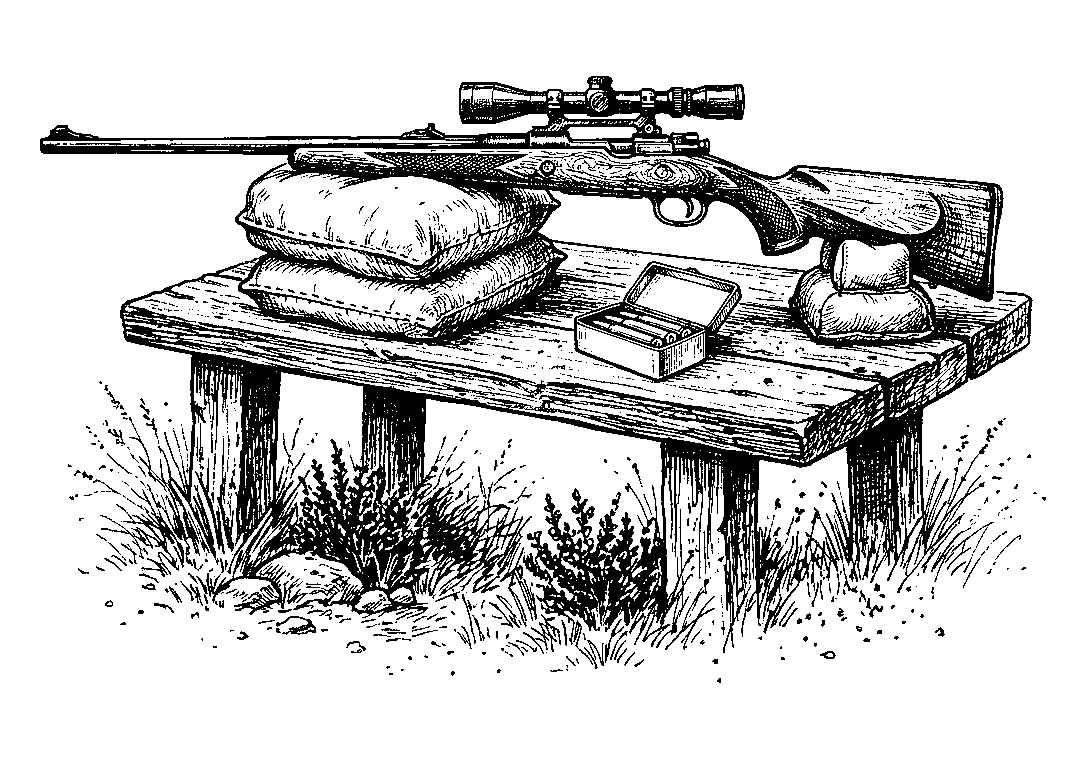
- Standard hunting zero
- Dead-on at 100 m/yd, or +4 cm (+1.5 in) at 100 for MPBR out to ~200 m
- MRAD (MIL) turret click
- 0.1 MRAD = 1.0 cm at 100 m (0.36 in at 100 yd)
- MOA turret click
- 1/4 MOA ≈ 0.73 cm at 100 m (0.26 in at 100 yd)
- Non-negotiable range habit
- Always confirm your final cold-bore shot with actual hunting ammo
On this page
A rifle that places its very first cold-bore shot exactly where the crosshair rests—in rain, wind or steep mountain terrain—is the bedrock of ethical hunting. Here is how to set up your zero, understand point-blank trajectory and execute steady shots in the field.
- Line of sight vs. bore axis: Your scope sits 4–5 cm (1.5–2 in) above the bore, so at very close range (under 25 m/yd) the bullet impacts slightly low.
- Near zero (~35–45 m/yd): The rising projectile first crosses your line of sight.
- Mid-range apex / MPBR (+3–4 cm at 100 m): Zeroing +4 cm (+1.5 in) at 100 keeps the bullet inside a ±4 cm corridor from muzzle to ~195 m (215 yd).
- Far zero (~160–180 m with +4 cm zero): Ideal for open clearcuts, tundra and hill stalking.
- Drop beyond 200 m/yd: Gravity accelerates drop sharply—measure with a laser rangefinder and dial using a verified drop chart.
Trajectory comparison: 100 m zero vs. MPBR (+4 cm)
Representative .308 Win 150 gr copper load (850 m/s / 2,790 fps):
| Distance | 100 m (0 cm) zero | MPBR (+4 cm / +1.6 in at 100 m) |
|---|---|---|
| 50 m (55 yd) | -0.8 cm (-0.3 in) | +1.2 cm (+0.5 in) |
| 100 m (109 yd) | 0.0 cm (0.0 in) | +4.0 cm (+1.6 in) |
| 150 m (164 yd) | -3.5 cm (-1.4 in) | +2.5 cm (+1.0 in) |
| 175 m (191 yd) | -6.8 cm (-2.7 in) | +0.2 cm (+0.1 in) |
| 200 m (219 yd) | -11.4 cm (-4.5 in) | -3.4 cm (-1.3 in) |
| 250 m (273 yd) | -24.6 cm (-9.7 in) | -14.6 cm (-5.7 in) |
Five-step range zeroing routine
- Bore-sight at 25–50 m/yd: Remove the bolt, rest the rifle steadily, centre the target through the bore and dial the reticle onto the bullseye.
- Fire a calm 3-shot group at 100 m/yd off sandbags or a bipod with a rear bag. Never chase single shots.
- Measure from point of aim to group centre and dial cleanly (0.1 MRAD = 1 cm at 100 m; 1/4 MOA = 0.26 in at 100 yd).
- Confirm with a fresh 3-shot group while letting the barrel cool between strings.
- Verify a cold-bore shot with your exact hunting ammunition before heading to the woods.
Field shooting habits
- Build a rock-solid rest: Prone over your pack, seated with elbows braced on knees, or standing off shooting sticks shrinks wobble dramatically compared to offhand shooting.
- Respect crosswind: A modest 5 m/s (11 mph) full-value crosswind pushes most hunting bullets 8–12 cm (3–5 in) sideways at 200 m/yd. Limit shots to distances you have practised in wind.
Related
Rifle Ammunition & Lead-Free Bullets
UK legal minimum rifle calibres, bullet weights and muzzle energies under the Deer Act 1991 (England & Wales) and Deer (Scotland) Act 1996, plus copper non-lead bullet transition.
Riflescope
Complete buyer's guide to hunting riflescopes: choosing magnification & objective lens size, twilight exit pupil, FFP vs. SFP reticles, illuminated dots and mounts.
Ballistic Tables
How to build and field-verify a rifle ballistic drop chart (DOPE card): chronographed velocity, MRAD vs. MOA clicks, wind column and waterproof scope-cap cards.
Frequently asked questions
Should I zero my hunting rifle dead-on at 100 m/yd or 4 cm (1.5 in) high?
If you hunt primarily in woodland at 30–130 m/yd, a 100 m/yd zero is crisp and easy to remember. If you hunt open hills or mountains out to 200 m/yd without dialling turrets, zeroing 4 cm (1.5 in) high at 100 keeps the bullet inside a deer's vital zone out to roughly 200 m/yd (Maximum Point-Blank Range).
How do steep uphill or downhill angles affect bullet impact?
Gravity acts only over the true horizontal distance to the target, not the slant line-of-sight distance. Your rifle therefore hits HIGH on both steep uphill and steep downhill shots. Always use an angle-compensating rangefinder in mountains.
Why does the cold-bore shot matter so much for hunters?
In the field you take your first shot through a cold, fouled hunting barrel—not a hot barrel on shot number twelve. Some lightweight barrels shift 2–4 cm as they heat up. Finish every range trip by letting the barrel cool fully and firing a single confirmation shot with your hunting load.
Plan your outing with Hunta
Share live maps, pegs, wind direction and bag limits for free with your syndicate, or discover available shooting ground in Norway.