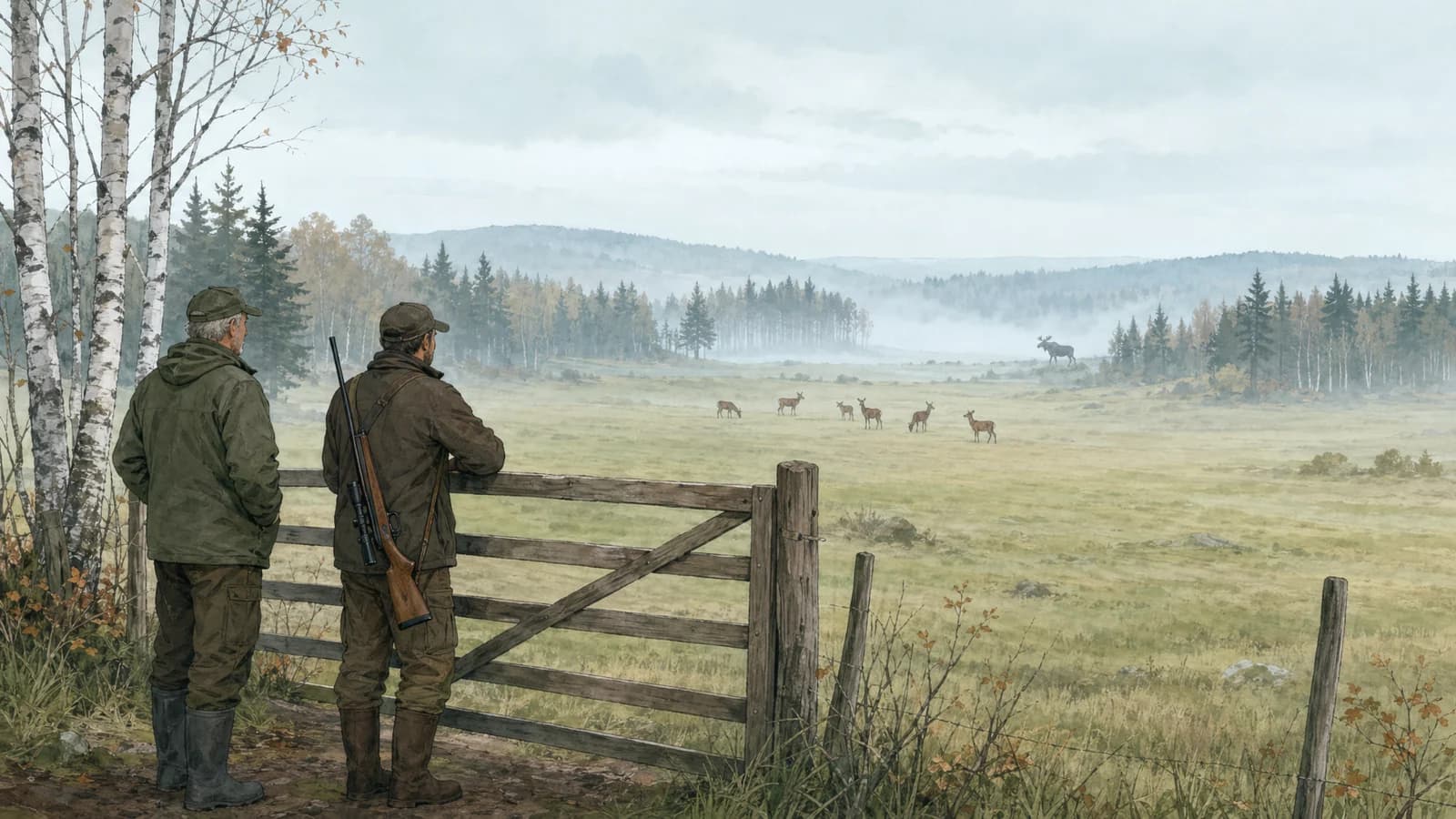
New National Deer Management Strategy: What Does It Actually Mean for Landowners and Hunters?
Landbruksdirektoratet (the Norwegian Agricultural Agency) and Miljødirektoratet (the Norwegian Environment Agency) have published a new national strategy for deer and cervid management covering 2026–2030.
Strategy documents often sound dry. This one is more practical than it looks.
It is relevant for everyone who holds hunting rights, hunts red deer, elk (moose), or roe deer, or cares about how Norwegian outland terrain will be used going forward.
The short version is simple: deer and cervid management is to become more holistic, more knowledge-based, and built on greater cross-boundary collaboration.
That is a good thing. The animals pay no attention to municipal boundaries. Neither does the terrain.
The Strategy Is About More Than Population Numbers
A lot of cervid debate quickly comes down to numbers.
How many animals are out there? How many should be harvested? Is the population too high or too low?
Those are important questions. But the strategy points at something bigger: how cervids connect with agriculture, forestry, road safety, hunting culture, wildlife health, and local livelihoods.
This is where it gets interesting.
Because cervids are not just a population to be regulated. They are also a resource. Part of the natural environment. Part of local communities. And for many landowners, they represent a value that can be managed far better than it is today.
Five Focus Areas Recur Throughout
The strategy identifies five priority areas in particular:
- cross-boundary management
- land-use conflicts
- wildlife health
- the future of hunting practice
- cervids as a commercial resource
The first point is perhaps the most obvious.
Elk, red deer, and roe deer move according to habitat, food, weather, shelter, and terrain — not according to lines on a map. Management therefore needs to align better across properties, municipalities, and counties.
That does not mean centralising all decisions. But it does mean that small, isolated decisions are often not enough.
The Role of Landowners Becomes More Important
If cervids are to be managed well, landowners must be part of the equation.
Landowners are close to the ground. They know the forest, the fields, the migration corridors, and the conflicts. They see where the animals move. They know where browsing damage occurs. They also know where hunting can actually be carried out safely and responsibly.
It is therefore encouraging that the strategy places emphasis on collaboration between authorities, landowners, and hunters.
But collaboration requires order.
Verbal agreements, old habits, and a few messages back and forth are not always enough. If hunting rights are to be used well, it must be clear what is on offer, who gets to hunt, what rules apply, and how the landowner retains control.
Cervids as a Commercial Resource Is a Key Point
One of the most interesting elements of the strategy is the treatment of cervids as a commercial resource.
There is a great deal of unrealised value here.
Not because all hunting should become expensive and exclusive — that is not the point. The point is that hunting rights in many places are managed too manually, priced too haphazardly, or underutilised.
For some landowners that means terrain sitting idle. For others it means hunting is leased out, but with more administration than necessary. And for hunters it often means that good opportunities are hard to find.
That is a poor outcome for both sides.
Good organisation can deliver more straightforward hunting arrangements, better control for landowners, and easier access for serious hunters.
Hunters Also Take on Greater Responsibility
The strategy also addresses the future of hunting practice.
It is not just about filling quotas. It is about how hunting is conducted, what legitimacy it carries, and what kind of population remains after the season.
That last point matters. Good hunting is not only about harvest numbers. It is also about age structure, sex ratio, body condition, timing, and an understanding of the terrain. A hunter who grasps the full picture is more valuable to a landowner than one who simply shows up and asks what can be shot.
This is why strong landowner–hunter relationships will become increasingly important going forward.
What Does This Mean in Practice?
For landowners, the strategy means that hunting rights should be viewed as a resource that can be better organised.
Not necessarily more complicated. Ideally simpler. Just more orderly.
That means:
- a clearer picture of what can actually be offered
- well-defined terms for hunters
- easier communication
- better oversight of who hunts where
- a stronger ability to create local value from the terrain
For hunters, it means that seriousness, understanding, and respect for the terrain become even more important.
That is not a bad development. It is how hunting keeps its social licence.
This Is Just the Beginning
The strategy is not a finished solution. It is a direction.
The real work happens out in the municipalities, in the hunting districts (vald), on individual properties, in hunting parties, and between the people who actually use the terrain.
But the direction is right.
More knowledge. More collaboration. A more holistic view. More local value creation.
That is exactly where Norwegian hunting needs to go.
At Hunta we are building for that reality: a simpler, more orderly way for landowners to showcase hunting opportunities, connect with the right hunters, and stay in control.
If you have hunting terrain you are considering leasing out, you can list it on Hunta and get started with no fixed costs.