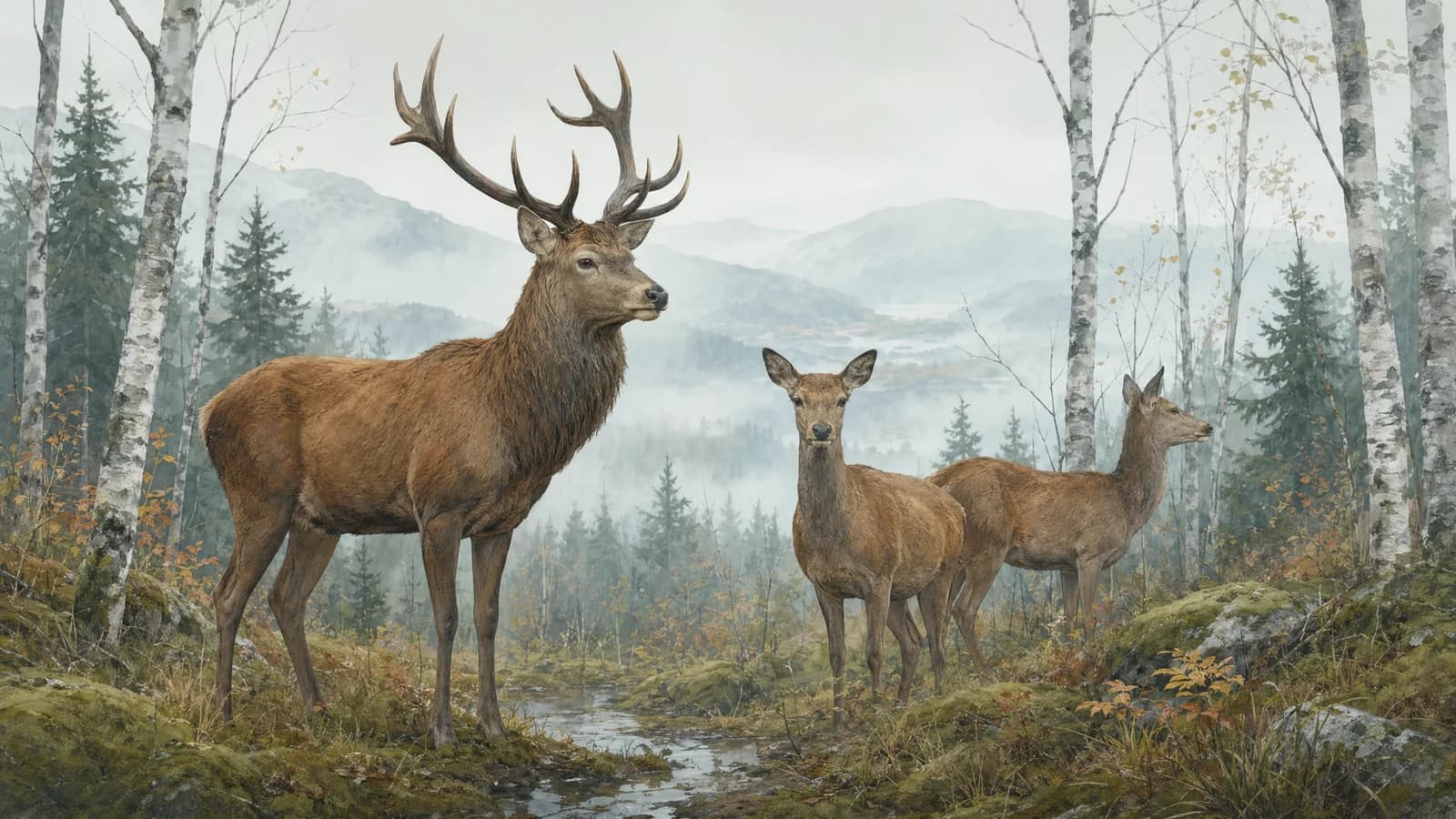
Everything you need to know about red deer hunting in Norway — seasons, regions, techniques, rifles, and bag limits. Did you know that more red deer than moose are now shot in several Norwegian municipalities?
Red Deer Hunting in Norway: The Complete Guide
By Aris Elgstad, CMO at Hunta
There is something special about standing on a Vestland hillside in September, dew on your beanie and a stag roaring somewhere along the forest edge below. Red deer hunting may be the most underrated form of hunting we have in Norway. While moose hunting gets most of the attention, red deer have quietly taken over as the most important big-game species across large parts of the country.
In several municipalities, more red deer are now shot than moose. This is not a trend — it is a reality that has been building for decades. The population has grown strongly, and with it interest in red deer hunting has exploded.
Here is everything you need to know to get started, or to get better.
Seasons and Season Structure
Red deer season in Norway opens on 1 September and runs until 23 December. That gives you almost four months, but the different periods have entirely different characters.
Early season (September): Deer are still on summer range and relatively predictable. The rut has not started, and you are often hunting animals that feed in open areas morning and evening.
The rut (October): This is the highlight for many hunters. Stags are roaring, active during the day, and you can use calling techniques. At the same time they are more unpredictable. The rut sends stags moving over large areas.
Late season (November to December): Quieter hunting. Deer move toward winter range, and snow makes tracking easier. Cold weather demands more of you as a hunter, but you can find deer gathered in herds.
Where in Norway Is Red Deer Hunting Best?
Vestland is without question Norway's prime red deer county. Municipalities such as Kvam, Kvinnherad, and Voss record some of the highest cull figures in the country. The Vestland landscape — steep hillsides, deciduous woodland, and mild winters — suits red deer perfectly.
But deer are found well beyond Vestland:
Trøndelag has seen strong population growth over the past twenty years
Innlandet and Viken have expanding herds, especially in the valley systems
The trend is clear: red deer are spreading eastward and northward. Areas that barely had any deer twenty years ago now carry huntable populations.
Red Deer Hunting in Norway: The Complete Guide
•7 min read
Everything you need to know about red deer hunting in Norway — seasons, regions, techniques, rifles, and bag limits. Did you know that more red deer than moose are now shot in several Norwegian municipalities?
Red Deer Hunting in Norway: The Complete Guide
By Aris Elgstad, CMO at Hunta
There is something special about standing on a Vestland hillside in September, dew on your beanie and a stag roaring somewhere along the forest edge below. Red deer hunting may be the most underrated form of hunting we have in Norway. While moose hunting gets most of the attention, red deer have quietly taken over as the most important big-game species across large parts of the country.
In several municipalities, more red deer are now shot than moose. This is not a trend — it is a reality that has been building for decades. The population has grown strongly, and with it interest in red deer hunting has exploded.
Here is everything you need to know to get started, or to get better.
Seasons and Season Structure
Red deer season in Norway opens on 1 September and runs until 23 December. That gives you almost four months, but the different periods have entirely different characters.
Early season (September): Deer are still on summer range and relatively predictable. The rut has not started, and you are often hunting animals that feed in open areas morning and evening.
The rut (October): This is the highlight for many hunters. Stags are roaring, active during the day, and you can use calling techniques. At the same time they are more unpredictable. The rut sends stags moving over large areas.
Late season (November to December): Quieter hunting. Deer move toward winter range, and snow makes tracking easier. Cold weather demands more of you as a hunter, but you can find deer gathered in herds.
Where in Norway Is Red Deer Hunting Best?
Vestland is without question Norway's prime red deer county. Municipalities such as Kvam, Kvinnherad, and Voss record some of the highest cull figures in the country. The Vestland landscape — steep hillsides, deciduous woodland, and mild winters — suits red deer perfectly.
But deer are found well beyond Vestland:
Trøndelag has seen strong population growth over the past twenty years
Innlandet and Viken have expanding herds, especially in the valley systems
The trend is clear: red deer are spreading eastward and northward. Areas that barely had any deer twenty years ago now carry huntable populations.
Hunting Techniques: How to Hunt Red Deer
Red deer hunting is about reading terrain, wind, and weather. Here are the most common techniques.
Stand Hunting
The classic approach. You position yourself at a stand with a good vantage point — ideally on a hillside overlooking a feeding area or a natural movement corridor. Patience is the key. Dawn and dusk are best, but during the rut things can happen at midday too.
Tip: Sit still. Red deer have excellent hearing and sharp eyes. Movement gives you away faster than scent.
Stalking
More active, and it requires experience. You move slowly through the terrain, ideally into the wind, trying to close the distance on deer. Works best in broken country with good cover.
Stalking during the rut can be very effective because stags are preoccupied with other things. But it demands constant attention to the wind. One wrong puff and the deer is gone.
Drive Hunting
Organised hunting where some members push the terrain while others stand at posts. Common in Vestland, especially in steep ground where deer follow fixed movement routes. Requires good planning and communication among hunters.
Calling During the Rut
With a roaring call or just your own voice, you can attract rutting stags in October. It takes practice to produce convincing sounds, but when it works it is an experience like no other. Start quietly and listen to the response before increasing the intensity.
Rifles and Calibres
Red deer are robust animals, and stags can weigh over 200 kilograms. You need a calibre that delivers enough energy at the distances you hunt.
The most common choices:
6.5×55 (Swedish Mauser): The classic. Works well on red deer to 150 metres, though many consider it at the lower end for large stags
308 Winchester: Versatile and popular. Good energy, affordable ammunition, and suits most hunting situations
.30-06 Springfield: A step up from the 308, and a safe choice for all red deer hunting
6.5 Creedmoor: Has grown popular in recent years. Flat-shooting and precise, with excellent reach
Whatever calibre you choose: train at the range. Accuracy matters more than calibre. A well-placed shot with a 6.5×55 beats a poorly placed shot with a .30-06 every single time.
Gear You Actually Need
Don't overthink this. Good red deer hunting depends more on knowledge than on gear, but some things are worth investing in:
Optics: A quality binocular is more important than an expensive rifle. You will use your binoculars ten times more than your rifle. 8×42 or 10×42 is the standard choice. And make sure the riflescope is of good quality too.
Clothing: Vestland weather means rain — a lot of it. Proper waterproof layering is not a luxury; it is a necessity. Avoid rustling fabrics. Wool next to the skin is hard to beat for silence and insulation.
Knife and field dressing kit: You need a sharp knife and you need to know how to use it. Practise field dressing before the season. It is a matter of respect for the animal and for the meat.
Pack: A good hunting pack with room for everything you need during a long day in the hills. Do not over-pack.
Bag Limits and Permits
To hunt red deer in Norway you need:
Hunter's certificate (Jegerprøven): Mandatory. The course takes around 30 hours and finishes with an exam
Paid hunting fee (jegeravgift): Annual state fee
Access to hunting ground: Either through a landowner association, a hunting team, or by leasing hunting rights
Shooting licence (fellingstillatelse): Quotas are allocated by the municipality to the registered hunting units (vald), which in turn distribute them to the hunting teams
The application deadline for quotas varies by municipality but is usually in spring. Check with your local vald or municipality well in advance. Many vald have their own websites where you can follow the process.
If you do not have access through family or acquaintances, there are several ways to break into red deer hunting. Some landowner associations sell day licences or seasonal tickets. In other places you can sign up as a guest hunter.
The Meat
A mature red deer yields 40 to 60 kilograms of clean meat, depending on size and condition. Venison is lean, flavourful, and versatile. Tenderloin and backstrap are obviously the highlights, but it is in slow-cooked stews and braises that red deer truly shines.
Treat the meat with respect from field to table. Rapid chilling and proper ageing make an enormous difference to the end product.
Join Hunta
We are building Hunta for hunters who want to get more out of their hunting. Whether you are a new hunter looking for a hunting team, or an experienced hunter wanting to share knowledge and experiences, you are welcome.
On Hunta you can find hunting ground, connect with other hunters in your area, and keep track of the season. We are still early in development, and feedback from real hunters shapes what we build.
Check out Hunta.no and become part of the community. You can also find an overview of seasons and regulations in the knowledge centre.
Hunting Techniques: How to Hunt Red Deer
Red deer hunting is about reading terrain, wind, and weather. Here are the most common techniques.
Stand Hunting
The classic approach. You position yourself at a stand with a good vantage point — ideally on a hillside overlooking a feeding area or a natural movement corridor. Patience is the key. Dawn and dusk are best, but during the rut things can happen at midday too.
Tip: Sit still. Red deer have excellent hearing and sharp eyes. Movement gives you away faster than scent.
Stalking
More active, and it requires experience. You move slowly through the terrain, ideally into the wind, trying to close the distance on deer. Works best in broken country with good cover.
Stalking during the rut can be very effective because stags are preoccupied with other things. But it demands constant attention to the wind. One wrong puff and the deer is gone.
Drive Hunting
Organised hunting where some members push the terrain while others stand at posts. Common in Vestland, especially in steep ground where deer follow fixed movement routes. Requires good planning and communication among hunters.
Calling During the Rut
With a roaring call or just your own voice, you can attract rutting stags in October. It takes practice to produce convincing sounds, but when it works it is an experience like no other. Start quietly and listen to the response before increasing the intensity.
Rifles and Calibres
Red deer are robust animals, and stags can weigh over 200 kilograms. You need a calibre that delivers enough energy at the distances you hunt.
The most common choices:
6.5×55 (Swedish Mauser): The classic. Works well on red deer to 150 metres, though many consider it at the lower end for large stags
308 Winchester: Versatile and popular. Good energy, affordable ammunition, and suits most hunting situations
.30-06 Springfield: A step up from the 308, and a safe choice for all red deer hunting
6.5 Creedmoor: Has grown popular in recent years. Flat-shooting and precise, with excellent reach
Whatever calibre you choose: train at the range. Accuracy matters more than calibre. A well-placed shot with a 6.5×55 beats a poorly placed shot with a .30-06 every single time.
Gear You Actually Need
Don't overthink this. Good red deer hunting depends more on knowledge than on gear, but some things are worth investing in:
Optics: A quality binocular is more important than an expensive rifle. You will use your binoculars ten times more than your rifle. 8×42 or 10×42 is the standard choice. And make sure the riflescope is of good quality too.
Clothing: Vestland weather means rain — a lot of it. Proper waterproof layering is not a luxury; it is a necessity. Avoid rustling fabrics. Wool next to the skin is hard to beat for silence and insulation.
Knife and field dressing kit: You need a sharp knife and you need to know how to use it. Practise field dressing before the season. It is a matter of respect for the animal and for the meat.
Pack: A good hunting pack with room for everything you need during a long day in the hills. Do not over-pack.
Bag Limits and Permits
To hunt red deer in Norway you need:
Hunter's certificate (Jegerprøven): Mandatory. The course takes around 30 hours and finishes with an exam
Paid hunting fee (jegeravgift): Annual state fee
Access to hunting ground: Either through a landowner association, a hunting team, or by leasing hunting rights
Shooting licence (fellingstillatelse): Quotas are allocated by the municipality to the registered hunting units (vald), which in turn distribute them to the hunting teams
The application deadline for quotas varies by municipality but is usually in spring. Check with your local vald or municipality well in advance. Many vald have their own websites where you can follow the process.
If you do not have access through family or acquaintances, there are several ways to break into red deer hunting. Some landowner associations sell day licences or seasonal tickets. In other places you can sign up as a guest hunter.
The Meat
A mature red deer yields 40 to 60 kilograms of clean meat, depending on size and condition. Venison is lean, flavourful, and versatile. Tenderloin and backstrap are obviously the highlights, but it is in slow-cooked stews and braises that red deer truly shines.
Treat the meat with respect from field to table. Rapid chilling and proper ageing make an enormous difference to the end product.
Join Hunta
We are building Hunta for hunters who want to get more out of their hunting. Whether you are a new hunter looking for a hunting team, or an experienced hunter wanting to share knowledge and experiences, you are welcome.
On Hunta you can find hunting ground, connect with other hunters in your area, and keep track of the season. We are still early in development, and feedback from real hunters shapes what we build.
Check out Hunta.no and become part of the community. You can also find an overview of seasons and regulations in the knowledge centre.
Red Deer Hunting in Norway: The Complete Guide | Hunta