Chamois
Rupicapra rupicapra
Big Game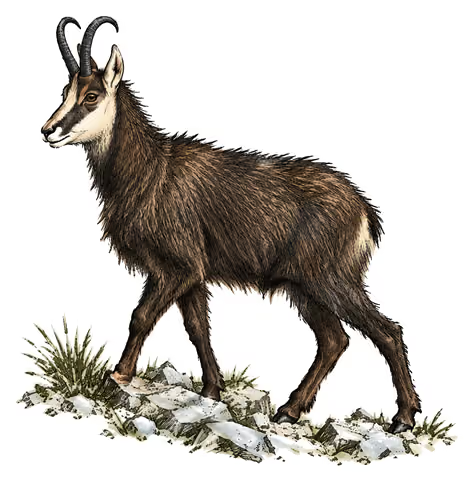
- Scientific name
- Rupicapra rupicapra (Pyrenees: R. pyrenaica)
- Adult weight
- 25–45 kg (55–100 lb)
- Open season
- Not native to the UK; Alps & Pyrenees: Aug – Dec; New Zealand: year-round
- Top destinations
- Austria, France, Germany (Bavaria), Spain, Slovenia & New Zealand
- Ideal calibres
- .243 Win, 6.5x55, 6.5 Creedmoor, .270 Win or .308 Win
The chamois (Rupicapra rupicapra) is the emblem of European alpine hunting. Equipped with pliable, high-grip hooves, it traverses sheer limestone faces and snowfields effortlessly across the Alps, Pyrenees and New Zealand's Southern Alps.
Chamois mountain kit at a glance
Because a chamois presents a relatively compact vital zone (25–45 kg) at alpine ranges, flat-shooting accuracy beats heavy recoil:
| Kit item | Alpine recommendation |
|---|---|
| Calibre | .243 Win, 6.5 Creedmoor, 6.5x55, .270 Win, 7mm-08 or .308 Win (note 6.5 mm minimum in Germany!) |
| Optics | 10x42 binoculars + angle-compensating rangefinder + dialable scope |
| Footwear | Rigid, crampon-ready or high-support mountain boots for scree & wet steep grass |
Continue with mountain hunting, Austria, France and New Zealand.
Identification
Stiff alpine mountain boots, merino layering and windproof shell
Fieldcraft Tips
Both sexes carry hooked black horns—bring crisp 10x42 binoculars or a spotting scope to sex bucks vs. does, and always dial for horizontal angle-compensated range.
Find shooting ground for chamois
Create a free account and find shooting ground where you can shoot chamois.
Other big game

Fallow Deer and Mouflon
Fallow bucks: 1 Aug – 30 Apr; does: 1 Nov – 31 Mar (Eng/Wales) / 21 Oct – 15 Feb (Scotland)

Elk (Moose)
Not native to the UK; Nordics & North America: Sep – Dec
Red Deer
Scotland: stags all year, hinds 21 Oct – 15 Feb; Eng/Wales: stags 1 Aug – 30 Apr, hinds 1 Nov – 31 Mar
White-tailed deer
Not native to the UK; Finland: 1 Sep – 15 Feb; North America: Sep – Jan

Roe Deer
Eng/Wales: bucks 1 Apr – 31 Oct, does 1 Nov – 31 Mar; Scotland: bucks 1 Apr – 20 Oct, does 21 Oct – 31 Mar
Sika deer
Scotland: stags all year, hinds 21 Oct – 15 Feb; Eng/Wales: stags 1 Aug – 30 Apr, hinds 1 Nov – 31 Mar
Frequently asked questions
How do you tell a male chamois (buck) from a female (doe)?
Both sexes grow black hooked horns. Mature bucks carry thicker horn bases with a tighter, deeper hook, heavier necks, a visible belly tuft and tend to roam solo outside the November rut, while does group together with kids.
What shot distances are common when hunting chamois?
Shots typically fall between 140 and 240 m (155–260 yd) across steep uphill or downhill angles. Practise shooting prone over a rucksack and always use an angle-compensating rangefinder.