Brown bear
Ursus arctos
Predators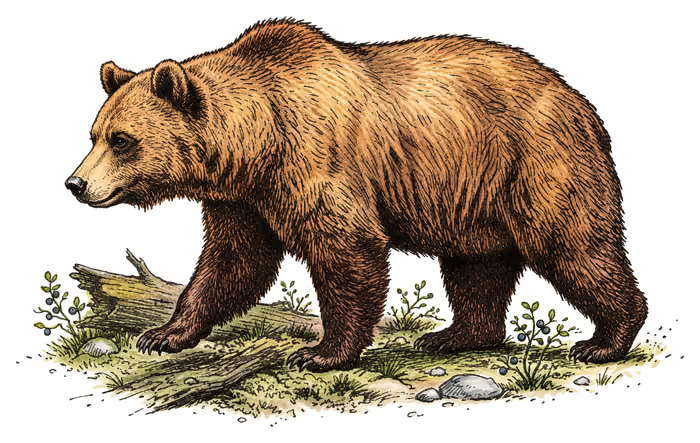
- Scientific name
- Ursus arctos
- Adult weight (Europe)
- Females 80–150 kg (175–330 lb); males 130–250 kg (285–550 lb)
- Typical season
- From 20–21 Aug (Sweden/Finland quota); spring & autumn (North America); protected in Western Europe
- Recommended calibres
- .30-06, 8x57 IS, .300 Win Mag, 9.3x62 or .375 H&H (bonded/copper)
- Food safety (mandatory)
- Lab Trichinella test + cook to 74 °C (165 °F); freezing does NOT kill Trichinella nativa
On this page
The brown bear (Ursus arctos) is Europe's largest terrestrial predator and one of the world's most respected big-game animals. Whether pursued during Nordic autumn quota hunts with baying spitz dogs or on guided wilderness trips in Alaska and British Columbia, brown bear hunting demands absolute discipline in safety, bullet selection and tracking readiness.
Biology and seasonal behaviour
Despite their size, brown bears are omnivores—relying heavily on blueberries, crowberries, roots, ants and vegetation during late summer and autumn, alongside carrion and spring moose calves. Their sense of smell is extraordinary, making wind discipline paramount on every stand or stalk.
Rifle, bullet and optics benchmarks
| Parameter | Recommended setup | Why it matters |
|---|---|---|
| European forest brown bear | .30-06, 8x57 IS, .300 Win Mag, 9.3x62 | Deep penetration and decisive stopping power |
| Coastal Alaskan brown bear | .338 Win Mag, .375 H&H, .416 Rigby | Heavy bone structure on 350–500 kg bears |
| Bullet construction | Monolithic copper or heavy bonded lead | Must drive through shoulder bone without fragmenting |
| Riflescope | Low-power variable (1–6x / 1.5–6x) | Wide field of view for fast timber shots |
Key legal and ethical obligations
- Never shoot a female accompanied by cubs—verify thoroughly that no cubs trail behind in thick brush.
- Monitor real-time quotas throughout every hunting day during Nordic licence hunts.
- Test every carcass for Trichinella: Review game meat hygiene before cooking.
See also Swedish Elkhound (Jämthund), hunting in Sweden and hunting in Canada.
Identification
Quiet forest layering plus high-visibility orange on team quota hunts
Hunting Tips
Use heavy controlled-expansion bullets (.30-06, 9.3x62, .338 Win Mag or .375 H&H), never shoot a sow with cubs, and always lab-test meat for Trichinella.
Find grounds for brown bear hunting
Create a free account and find hunting grounds where you can hunt brown bear.
Other predators

Lynx
Feb – Mar quota hunting in Norway & Sweden; strictly protected in Western & Central Europe

Badger
Aug – Jan/Feb (Nordics & parts of mainland Europe); strictly protected in the UK, Denmark & Spain

Pine Marten
Nov – Mar (Nordics); strictly protected in the UK, Denmark & Spain

Raccoon Dog
Year-round invasive-species management across Northern & Central Europe

Red Fox
Autumn – winter across mainland Europe; year-round in the UK (protect nursing vixens)

Stoat
Autumn – winter (Nordics); regulated control in the UK; protected in Denmark & Spain
Frequently asked questions
Where is brown bear hunting legally conducted?
Sweden and Finland run well-managed annual quota hunts beginning 20–21 August, Norway allows tightly capped regional licence hunts (21 Aug–15 Oct), and regulated hunts also operate in Estonia, Alaska, British Columbia and Yukon. Sows accompanied by cubs are universally protected.
How does brown bear shot placement differ from deer?
Thick autumn fur and fat layers visually exaggerate a bear's outline. On a broadside bear, aim directly behind the front shoulder blade into the middle-to-lower third of the chest using a tough bonded or monolithic bullet, and be ready to cycle immediately for a follow-up shot.
Is brown bear meat safe to eat?
Yes—autumn berry-fed bear is prized table fare—provided it passes a mandatory laboratory Trichinella test and is cooked thoroughly to at least 74 °C (165 °F). Home freezing does not eliminate freeze-resistant northern Trichinella strains.