Hunting Ammunition & Lead-Free Bullets
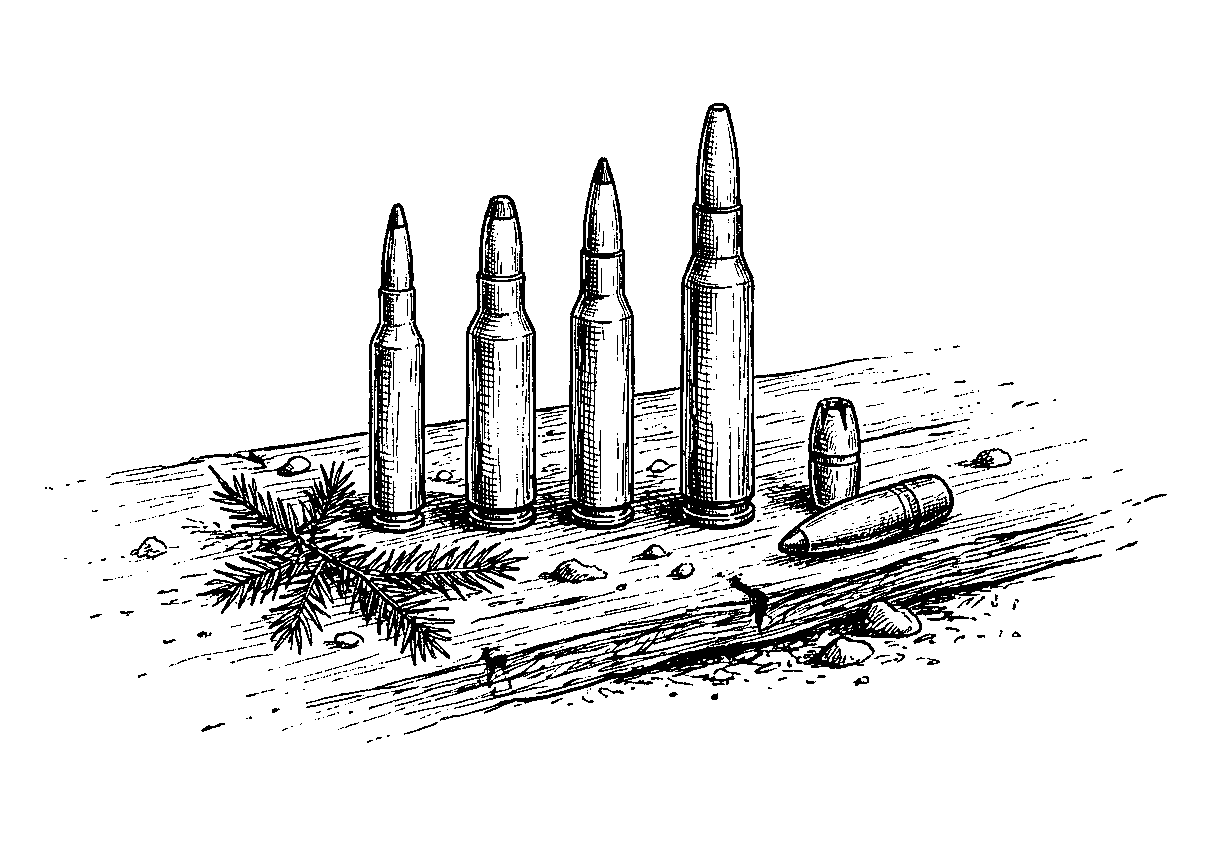
- Modern big-game gold standard
- Monolithic copper (lead-free) or chemically bonded lead-core
- Copper expansion floor
- Typically requires > 600 m/s (2,000 fps) impact velocity for full petals
- Non-lead trend
- Mandatory in Denmark, German state forests, California & growing EU zones
- Weight retention goal
- 85–100 % retention yields deep penetration and clean venison
On this page
Cartridge choice sets velocity and recoil, but bullet construction governs what actually happens inside the animal. A well-matched hunting bullet expands reliably in vital tissue yet stays intact through heavy shoulder bones to produce clean exit wounds and dependable blood trails.
Comparing the five main hunting bullet designs
| Bullet design | Popular examples | Weight retention | Best suited for | Watch-outs |
|---|---|---|---|---|
| Monolithic copper (lead-free) | Barnes TTSX, Norma Ecostrike, Lapua Naturalis, Fox | 95–100 % | Moose, red/whitetail/roe deer, boar, plains game; lead-free meat | Needs higher impact speed (> 600 m/s / 2,000 fps); step down 15–25 gr |
| Bonded lead-core | Norma Oryx, Sako Hammerhead, Federal Terminal Ascent | 80–92 % | All-round big game, heavy bone and moderate-velocity cartridges | Trim 10 cm (4 in) around wound channel for lead hygiene |
| Dual-core / partitioned | Nosler Partition, Swift A-Frame | 70–90 % | Heavy game (moose, elk, bear, kudu, eland) | Front core sheds minor lead fragments |
| Traditional cup-and-core | Norma Vulkan, Sako Gamehead, Hornady InterLock | 50–75 % | Roe deer & medium deer at modest velocities (< 800 m/s / 2,600 fps) | Can fragment and cause heavy bruising at magnum velocities |
| Full Metal Jacket (FMJ) | Lapua FMJ, Norma Jaktmatch | ~100 % (no exp.) | Treetop capercaillie, black grouse, furbearers | Illegal for deer and big game |
Choosing the right copper bullet weight
Because solid copper is lighter than lead, a 150 gr (9.7 g) copper projectile matches a 180 gr (11.7 g) lead bullet in length and often out-penetrates it while flying faster:
- 6.5x55 / 6.5 Creedmoor: 120–130 gr (7.8–8.4 g) copper (verify local legal bullet-weight minimums!) or 140–156 gr bonded lead.
- .308 Win / .30-06: 150–165 gr (9.7–10.7 g) copper or 165–180 gr bonded lead.
- 9.3x62: 230–250 gr (15–16.2 g) copper or 250–285 gr bonded lead.
Testing a new load before opening day
- Deep-clean barrel fouling when switching between gilding-metal lead bullets and pure copper bullets, then fire 3–5 fouling shots before checking groups.
- Test magazine feeding smoothly at hunting speed.
- Confirm drop at 100 and 200 m/yd—see our guides to zeroing and ballistics and game meat hygiene.
Related
.30-06 Springfield
Complete guide to .30-06 Springfield: over a century of global big-game reliability—ballistics table, heavy 180–200 gr bullets, barrel length and .308 comparison.
.308 Winchester
Complete guide to .308 Winchester: world's #1 all-round hunting cartridge—ballistics table, short suppressed barrels, 150–180 gr bullets and comparison with .30-06.
6.5x55 Swedish Mauser
Complete guide to 6.5x55 Swedish (6.5x55 SE): metric & imperial ballistics, big-game legality in the Nordics, mild recoil, copper bullets and comparison with .308 Win.
Zeroing Your Rifle & Field Shooting
How to zero your hunting rifle cleanly: 100 m/yd zero vs. MPBR (+4 cm / +1.5 in), MRAD and MOA clicks, wind drift, steep uphill/downhill angles and cold-bore verification.
Frequently asked questions
What are the pros and cons of monolithic copper (lead-free) hunting bullets?
Copper bullets retain 95–100 % of their weight, drive deep through heavy bone, leave minimal bloodshot meat and leave zero lead fragments in your venison. Because copper is less dense than lead, step down one weight class (for example 150 gr instead of 180 gr in .308 Win) to keep impact velocity above ~600 m/s (2,000 fps) for reliable expansion.
Can I hunt deer or big game with FMJ or match target bullets?
No. Full Metal Jacket (FMJ) bullets are illegal for big game across Europe and North America because they fail to expand and risk wounding. Thin-jacketed target/match bullets can splash on heavy shoulder bone without reaching the heart and lungs. Reserve FMJ strictly for edible upland birds such as capercaillie and grouse.
Why does bullet design matter more than cartridge size?
A tough bonded or monolithic bullet in 6.5x55 or .308 Win consistently out-penetrates and ruins far less venison than a fragile soft-point driven too fast out of a .300 Win Mag.
Plan your hunt with Hunta
Share live maps, stands, wind direction and quotas for free with your hunting team, or discover available hunting grounds in Norway.