Sound Moderator & Suppressor
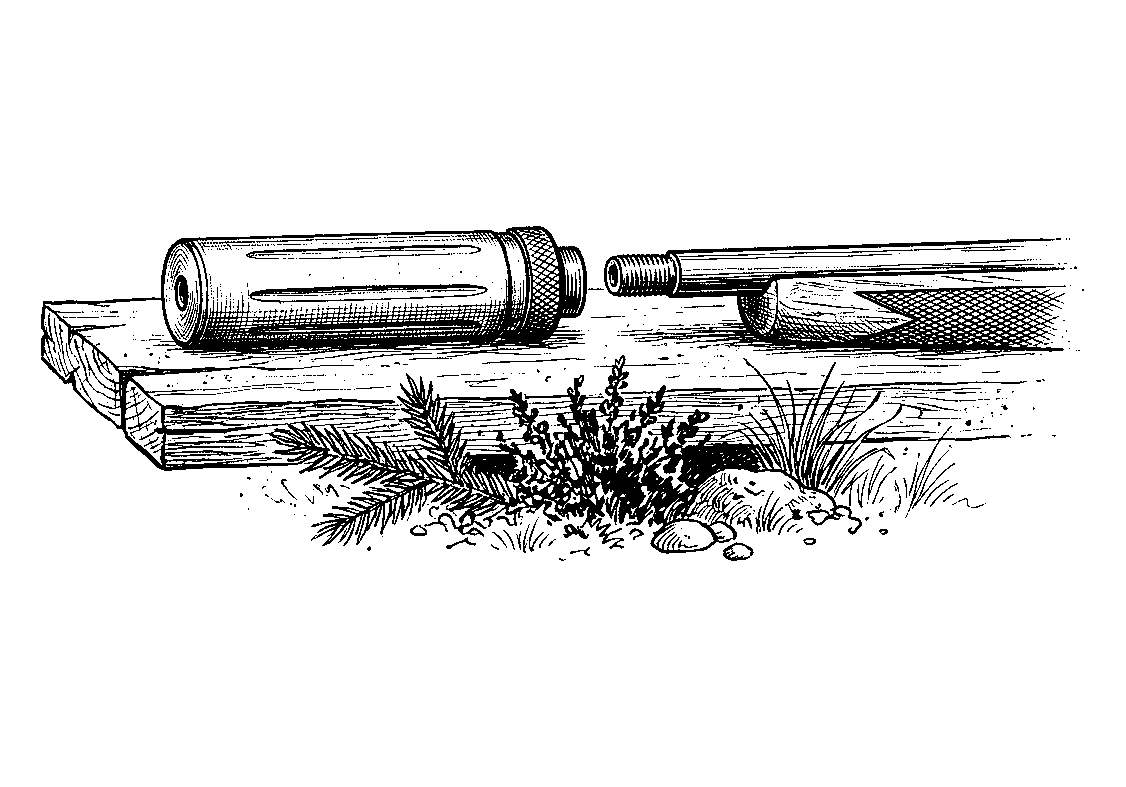
- Typical sound reduction
- 25–35 dB (brings ~165 dB muzzle blast down to ~132–138 dB)
- Recoil reduction
- 30–45 % less felt recoil—easier to spot bullet impact
- Common muzzle threads
- M14x1, M15x1, M18x1 (Europe); 1/2-28 & 5/8-24 (US/UK)
- International legality
- Legal in Nordics, UK, DE, FR, AT, ZA, NZ—BANNED in Spain, Canada & for US visitors
On this page
A hunting suppressor (sound moderator) is one of the highest-value upgrades you can add to a field rifle. It protects both hunter and gundog hearing, cuts felt recoil by 30–45 %, kills twilight muzzle flash and lets you stay on target through the scope to watch the animal's reaction.
Over-barrel vs. end-mount designs
| Feature | Over-barrel (telescopic/reflex) | End-mount (front-mounted) |
|---|---|---|
| Added overall length | +10–15 cm (4–6 in) past muzzle | +14–20 cm (5.5–8 in) past muzzle |
| Handling & balance | Better balance for offhand/driven shots | More muzzle-forward; great off bipod/sticks |
| Typical weight | 300–450 g (10.5–16 oz) | 220–360 g (8–12.5 oz) |
| Best suited for | All-round woodland & mountain rifles | Compact rifles, thin barrels, open sights |
Materials, mirage and barrel length
- Aluminium vs. titanium & steel: Lightweight aluminium moderators shine for mountain stalking but overheat quickly during long range strings. Steel-baffle or 3D-printed titanium cores handle heavy practice volumes far better.
- Heat mirage: Three to five range shots produce heat waves that distort your sight picture. A neoprene or Cordura mirage cover curbs shimmer and silences metallic taps against brush.
- Shortened barrels: Many hunters shorten barrels to 47–51 cm (18.5–20 in) to keep suppressed rifles nimble. Account for ~3–5 m/s (10–15 fps) velocity loss per cm removed and verify your load still meets legal big-game energy floors.
Maintenance habits that save barrels
- Unscrew after every outing—never store a rifle inside a safe with the moderator fitted.
- Air-dry upright in a warm room so acidic condensation evaporates completely.
- Lightly grease muzzle threads with high-temp anti-seize and check tightness regularly.
- Verify travel legality before flying: Legal across the Nordics, UK (listed on Visitor's Permit), Germany, France, Austria, South Africa and New Zealand; prohibited in Spain, Canada and for non-U.S. visitors entering the United States.
Continue with electronic hearing protection, zeroing and shooting and traveling with firearms.
Related
Bolt-action Rifle
Complete guide to hunting bolt-action rifles: unmatched reliability in snow and rain, push-feed vs controlled-round feed, triggers, stocks and international travel.
Traveling & Flying with Hunting Firearms
Step-by-step hunter's checklist for flying and crossing borders with rifles or shotguns: EU Firearms Pass, IATA 5 kg ammo rule, hard cases, transit pitfalls and country permits.
Zeroing Your Rifle & Field Shooting
How to zero your hunting rifle cleanly: 100 m/yd zero vs. MPBR (+4 cm / +1.5 in), MRAD and MOA clicks, wind drift, steep uphill/downhill angles and cold-bore verification.
Frequently asked questions
Does a rifle suppressor make hearing protection unnecessary?
No. While a good hunting suppressor dramatically cuts muzzle blast and protects your dog's ears, a supersonic hunting rifle still registers around 132–138 dB at the shooter's ear—right beside the hearing-damage threshold. Wear active electronic ear protection on the range and whenever practical in the field.
Will attaching a suppressor change my rifle's point of impact?
Almost always, typically by 2–8 cm (1–3 in) at 100 m/yd due to altered barrel harmonics and muzzle weight. Always zero your rifle with the suppressor firmly mounted and verify tightness before hunting.
Why should you always remove a suppressor immediately after hunting?
Combustion gases contain acidic moisture and salts that condense inside a warm suppressor and run straight down into the rifle bore if stored attached, pitting the crown and rifling. Unscrew it immediately and dry it in a warm room.
What is the difference between over-barrel and end-mount suppressors?
Over-barrel (reflex/telescopic) designs sleeve back over the barrel, keeping overall rifle length shorter and balance closer to the hands. End-mount suppressors are lighter and simpler but add more length past the muzzle.
Plan your hunt with Hunta
Share live maps, stands, wind direction and quotas for free with your hunting team, or discover available hunting grounds in Norway.