Two in three in Norway's Register of Hunters do not hunt
The register grows, the hunting stands still
558,527 Norwegians were in the Register of Hunters (Jegerregisteret) when the 2025-2026 hunting year ended. All of them are qualified to hunt. 184,747 of them paid the hunting fee (jegeravgift), which you must pay to hunt in Norway.
That is one in three. 373,780 did not.
It has not always been like this. In the 2001-2002 hunting year, one in two paid. Since then the register has gained 193,000 names, while the number who pay is roughly where it was.
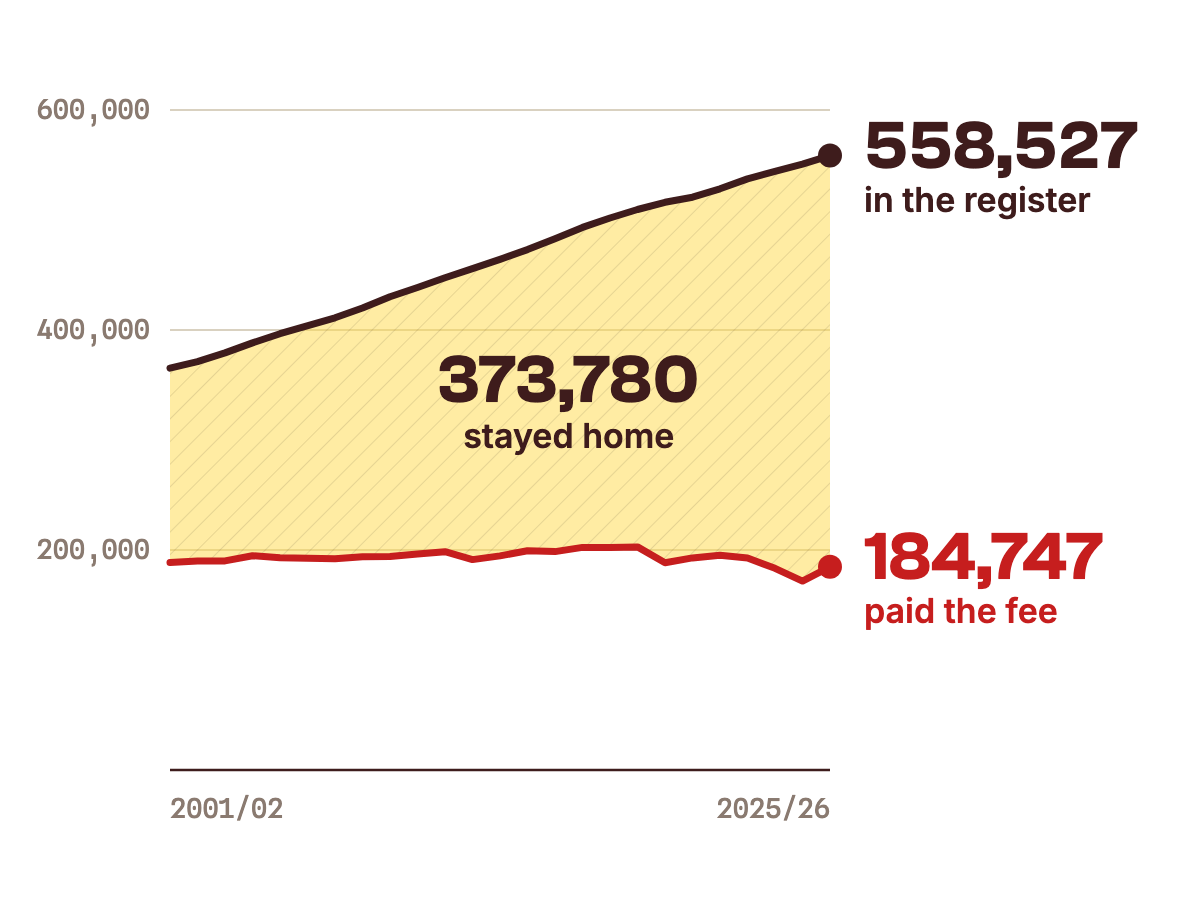
| Hunting year | In the register | Paid | Share |
|---|---|---|---|
| 2001-2002 | 365,292 | 188,646 | 52% |
| 2015-2016 | 482,988 | 198,541 | 41% |
| 2025-2026 | 558,527 | 184,747 | 33% |
The figures are from Statistics Norway.
It is not only the oldest
Once you are in the Register of Hunters, you usually stay there. So it is easy to think the gap is made up of hunters who have hung up the rifle for good. That is part of the picture. Among those over 70, 22 percent paid.
But in every age group under 70, the share is between 34 and 38 percent. Of those in their thirties, one in two paid in 2001-2002. Now one in three does.
The new ones drop off first
12,171 people passed the hunting test (jegerprøven) in the 2025-2026 hunting year. That is 11 percent more than the year before. 3,636 of them paid the hunting fee in the same hunting year, or three in ten. Ten years earlier, one in two did.
Some took the test too late to make the autumn hunt, but that was true ten years ago as well.
Women are the fastest-growing group in the register. 94,249 women are in it now, and 18,659 of them paid. That is one in five. Among men it is just over one in three.
Not everyone who pays gets out
Statistics Norway also counts who actually went hunting. The latest figures are for the 2023-2024 hunting year. That year 183,375 paid the hunting fee, and 130,300 hunted. That is seven in ten.
Measured against the whole register, one in four went hunting that year.
Why do they stay home?
Part of it is the ptarmigan. Statistics Norway points to low numbers of birds and closed grounds as a likely reason why the number of paying hunters fell two years in a row, from 192,788 to 171,738. Last hunting year it rose again by 13,000.
But the ptarmigan explains the swings, not the long gap.
The Norwegian Institute for Nature Research (NINA) has asked those who stayed home, on behalf of the Norwegian Association of Hunters and Anglers (NJFF). The survey went to people who had passed the hunting test without paying the hunting fee afterwards, and was covered by the magazine Jeger in 2023. Three things came up again and again: They had no access to a firearm. They were unsure about hunting on their own. And they did not know where they could hunt, or how to get into a hunting party.
The researchers recommended introductory hunts, mentoring schemes and better information after the test.
That matches what we hear. Much of the hunting in Norway goes through people you know. If you did not grow up in a hunting party, it is hard to see where the hunting is, what it costs and who to ask.
What we are doing about it
We are building Hunta to make the road from hunting test to hunt shorter.
- Hunting should be possible to find. On Hunta you find hunting from landowner associations and clubs, with the price and with the boundaries on the map.
- It should be safe to bring someone new. In the app, everyone on the hunt sees each other on the map, along with the boundaries of the ground.
- Nobody should have to go alone the first time. We are working on a guide as an add-on to the hunt, local or professional.
If you are new, you can start with small game hunting or read how to join a hunting party.
If you have hunting that could be listed, there are 373,780 qualified hunters who did not use their right last hunting year. Get in touch.
The cover image is an AI-generated illustration.